In Comparing Hellenic to Hellenistic Arts and Literature We Find That


From left to correct:
the Venus de Milo, discovered at the Greek island of Milos, 130–100 BC, Louvre
the Winged Victory of Samothrace, from the island of Samothrace, 200–190 BC, Louvre
Pergamon Altar, Pergamon Museum, Berlin.
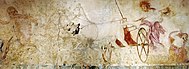
Hades abducting Persephone, fresco in the royal tomb at Vergina, Macedonia, Greece, c. 340 BC
Hellenistic fine art is the fine art of the Hellenistic period by and large taken to begin with the decease of Alexander the Great in 323 BC and end with the conquest of the Greek world past the Romans, a process well underway by 146 BCE, when the Greek mainland was taken, and essentially ending in thirty BCE with the conquest of Ptolemaic Arab republic of egypt following the Boxing of Actium. A number of the best-known works of Greek sculpture belong to this catamenia, including Laocoön and His Sons, Venus de Milo, and the Winged Victory of Samothrace. It follows the menstruation of Classical Greek art, while the succeeding Greco-Roman fine art was very largely a continuation of Hellenistic trends.
The term Hellenistic refers to the expansion of Greek influence and broadcasting of its ideas following the death of Alexander – the "Hellenizing" of the earth,[ane] with Koine Greek equally a mutual linguistic communication.[2] The term is a modern invention; the Hellenistic World not only included a huge surface area covering the whole of the Aegean Ocean, rather than the Classical Hellenic republic focused on the Poleis of Athens and Sparta, but also a huge time range. In artistic terms this ways that there is huge variety which is often put under the heading of "Hellenistic Fine art" for convenience.
1 of the defining characteristics of the Hellenistic period was the sectionalization of Alexander'due south empire into smaller dynastic empires founded by the diadochi (Alexander's generals who became regents of different regions): the Ptolemies in Egypt, the Seleucids in Mesopotamia, Persia, and Syrian arab republic, the Attalids in Pergamon, etc. Each of these dynasties practiced a royal patronage which differed from those of the city-states. In Alexander's entourage were three artists: Lysippus the sculptor, Apelles the painter, and Pyrgoteles the gem cutter and engraver.[iii] The menstruum after his death was i of keen prosperity and considerable extravagance for much of the Greek world, at least for the wealthy. Royalty became important patrons of art. Sculpture, painting and architecture thrived, simply vase-painting ceased to exist of bang-up significance. Metalwork and a wide variety of luxury arts produced much fine art. Some types of popular art were increasingly sophisticated.
In that location has been a trend in writing history to depict Hellenistic art as a decadent way, following the Gilded Historic period of Classical Hellenic republic. The 18th century terms Baroque and Rococo accept sometimes been applied to the art of this circuitous and individual period. A renewed involvement in historiography as well as some contempo discoveries, such as the tombs of Vergina, may allow a better appreciation of the period.
Architecture [edit]
In the architectural field, the dynasties following Hector resulted in vast urban plans and big complexes which had by and large disappeared from city-states by the fifth century BC.[five] The Doric Temple was virtually abased.[6] This city planning was quite innovative for the Greek world; rather than manipulating space by correcting its faults, building plans conformed to the natural setting. One notes the appearance of many places of amusement and leisure, notably the multiplication of theatres and parks. The Hellenistic monarchies were advantaged in this regard in that they ofttimes had vast spaces where they could build large cities: such equally Antioch, Pergamon, and Seleucia on the Tigris.
It was the time of gigantism: thus information technology was for the 2nd temple of Apollo at Didyma, situated 20 kilometers from Miletus in Ionia. It was designed by Daphnis of Miletus and Paionios of Ephesus at the cease of the 4th century BC, merely the structure, never completed, was carried out upward until the second century AD. The sanctuary is one of the largest ever synthetic in the Mediterranean region: inside a vast courtroom (21.7 metres by 53.half dozen metres), the cella is surrounded by a double colonnade of 108 Ionic columns nearly xx metres alpine, with richly sculpted bases and capitals.[7]
Athens [edit]
The Corinthian order was used for the first time on a full-calibration edifice at the Temple of Olympian Zeus.[8]
Olynthus [edit]
The aboriginal city of Olynthus was one of the architectural and creative keystones in establishing a connectedness between the Classical and Hellenistic worlds.
Over 100 homes were found at the Olynthus city site. Interestingly, the homes and other architecture were incredibly well preserved. This allows united states of america to meliorate understand the activities that took place in the homes and how space within the homes was organized and utilized.
Homes in Olynthus were typically squarer in shape. The desired home was non necessarily big or extravagant, but rather comfortable and applied. This was a mark of civilisation that was extremely prominent in Greek culture during the Hellenistic period and across. Living a civilized life involved maintaining a sturdy living infinite, thus many brick-like materials were used in the structure of the homes. Rock, wood, mudbrick, and other materials were commonly used to build these dwellings.
Another chemical element that was increasingly popular during the Hellenistic period was the add-on of a courtyard to the home. Courtyards served as a light source for the home every bit Greek houses were closed off from the outside to maintain a level of privacy. There accept been windows found at some home sites, but they are typically high off the basis and pocket-size. Considering of the event of privacy, many individuals were forced to compromise on light in the abode. Well-lit spaces were used for entertaining or more than public activity while the individual sectors of the dwelling were dark and closed off which complicated housework.
Courtyards were typically the focus of the home as they provided a space for entertaining and a source of light from the very interior of the domicile. They were paved with cobblestones or pebbles about often, but at that place accept been discoveries of mosaicked courtyards. Mosaics were a wonderful mode for the family to limited their interests and beliefs likewise as a way to add décor to the home and make it more visually highly-seasoned. This creative touch to homes at Olynthus introduces some other chemical element of civilized living to this Hellenistic society.[9]
Pergamon [edit]
Pergamon in particular is a characteristic instance of Hellenistic compages. Starting from a simple fortress located on the Acropolis, the various Attalid kings gear up a colossal architectural complex. The buildings are fanned out around the Acropolis to accept into account the nature of the terrain. The agora, located to the south on the everyman terrace, is bordered by galleries with colonnades (columns) or stoai. Information technology is the first of a street which crosses the entire Acropolis: it separates the administrative, political and military machine buildings on the east and peak of the rock from the sanctuaries to the west, at mid-height, amidst which the most prominent is that which shelters the monumental Pergamon Altar, known as "of the twelve gods" or "of the gods and of the giants", one of the masterpieces of Greek sculpture. A colossal theatre, able to contain nearly 10,000 spectators, has benches embedded in the flanks of the loma.[10]
Sculpture [edit]

Pliny the Elder, after having described the sculpture of the classical period notes: Cessavit deinde ars ("then fine art disappeared").[eleven] According to Pliny's cess, sculpture declined significantly later the 121st Olympiad (296–293 BC). A menstruum of stagnation followed, with a brief revival afterwards the 156th (156–153 BC), merely with nothing to the standard of the times preceding it.[12]
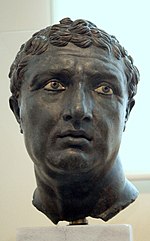
Bronze portrait of an unknown sitter, with inlaid optics, Hellenistic menstruation, 1st century BC, found in Lake Palestra of the Island of Delos.
During this menses sculpture became more naturalistic, and also expressive; there is an interest in depicting extremes of emotion. On pinnacle of anatomical realism, the Hellenistic creative person seeks to represent the character of his bailiwick, including themes such equally suffering, sleep or old historic period. Genre subjects of common people, women, children, animals and domestic scenes became acceptable subjects for sculpture, which was deputed past wealthy families for the adornment of their homes and gardens; the Boy with Thorn is an case.

The Barberini Faun, second-century BC Hellenistic or 2nd-century Advertisement Roman copy of an before bronze
Realistic portraits of men and women of all ages were produced, and sculptors no longer felt obliged to draw people as ideals of dazzler or physical perfection.[thirteen] The globe of Dionysus, a pastoral idyll populated past satyrs, maenads, nymphs and sileni, had been often depicted in earlier vase painting and figurines, but rarely in total-size sculpture. The Old Drunk at Munich portrays without reservation an one-time adult female, sparse, haggard, clutching against herself her jar of wine.[14]
Portraiture [edit]
The period is therefore notable for its portraits: One such is the Barberini Faun of Munich, which represents a sleeping satyr with relaxed posture and anxious face up, perhaps the prey of nightmares. The Dais Torso, the Resting Satyr, the Furietti Centaurs and Sleeping Hermaphroditus reflect similar ideas.[15]
Another famous Hellenistic portrait is that of Demosthenes by Polyeuktos, featuring a well-done face and clasped hands.[12]
Privatization [edit]
Another phenomenon of the Hellenistic age appears in its sculpture: privatization,[sixteen] [17] seen in the recapture of older public patterns in decorative sculpture.[18] Portraiture is tinged with naturalism, under the influence of Roman art.[19] New Hellenistic cities were springing up all over Egypt, Syria, and Anatolia, which required statues depicting the gods and heroes of Greece for their temples and public places. This made sculpture, like pottery, an industry, with the consequent standardization and some lowering of quality. For these reasons many more Hellenistic statues have survived than is the case with the Classical catamenia.
2d classicism [edit]
Hellenistic sculpture repeats the innovations of the then-called "2d classicism": nude sculpture-in-the-round, allowing the statue to be admired from all angles; study of draping and effects of transparency of article of clothing, and the suppleness of poses.[20] Thus, Venus de Milo, even while echoing a classic model, is distinguished by the twist of her hips.
"Baroque" [edit]
The multi-figure group of statues was a Hellenistic innovation, probably of the 3rd century, taking the ballsy battles of before temple pediment reliefs off their walls, and placing them as life-size groups of statues. Their style is often called "baroque", with extravagantly contorted body poses, and intense expressions in the faces. The Laocoön Group, detailed below, is considered one of the prototypical examples of the Hellenistic bizarre style.[21]
Pergamon [edit]

Pergamon did not distinguish itself with its architecture lonely: it was also the seat of a brilliant school of sculpture known as Pergamene Bizarre.[22] The sculptors, imitating the preceding centuries, portray painful moments rendered expressive with 3-dimensional compositions, ofttimes Five-shaped, and anatomical hyper-realism. The Barberini Faun is ane case.
Gauls [edit]
Attalus I (269–197 BC), to commemorate his victory at Caicus against the Gauls;— called Galatians by the Greeks – had ii series of votive groups sculpted: the first, consecrated on the Acropolis of Pergamon, includes the famous Gaul killing himself and his married woman, of which the original is lost; the 2nd group, offered to Athens, is composed of small bronzes of Greeks, Amazons, gods and giants, Persians and Gauls.[23] Artemis Rospigliosi in the Louvre is probably a copy of 1 of them; as for copies of the Dying Gaul, they were very numerous in the Roman period. The expression of sentiments, the forcefulness of details – bushy pilus and moustaches hither – and the violence of the movements are feature of the Pergamene style.[24]
Groovy Altar [edit]
These characteristics are pushed to their peak in the friezes of the Nifty Altar of Pergamon, decorated nether the order of Eumenes II (197–159 BC) with a gigantomachy stretching 110 metres in length, illustrating in the stone a verse form composed specially for the court. The Olympians triumph in it, each on his side, over Giants – most of which are transformed into vicious beasts: serpents, birds of prey, lions or bulls. Their mother Gaia comes to their aid, only can exercise nothing and must lookout them twist in pain under the blows of the gods.[25]
Colossus of Rhodes [edit]
Ane of the few city states who managed to maintain full independence from the control of any Hellenistic kingdom was Rhodes. Afterward belongings out for one year under siege by Demetrius Poliorcetes (305–304 BCE), the Rhodians built the Colossus of Rhodes to commemorate their victory.[26] With a height of 32 meters, it was ane of the Seven Wonders of the Ancient World. Progress in bronze casting made it possible for the Greeks to create big works. Many of the big statuary statues were lost – with the bulk beingness melted to recover the material.
Laocoön [edit]
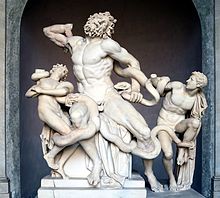
Discovered in Rome in 1506 and seen immediately past Michelangelo,[27] beginning its huge influence on Renaissance and Baroque art. Laocoön, strangled by snakes, tries desperately to loosen their grip without affording a glance at his dying sons. The group is ane of very few non-architectural ancient sculptures that tin be identified with those mentioned by aboriginal writers. It is attributed past Pliny the Elder to the Rhodian sculptors Agesander, Athenodoros, and Polydorus.[27]

The fundamental group of the Sperlonga sculptures, with the Blinding of Polyphemus; bandage reconstruction of the group, with at the correct the original effigy of the "wineskin-bearer" seen in front of the bandage version.
Johann Joachim Winckelmann, who first articulated the difference between Greek, Greco-Roman and Roman fine art, drew inspiration from the Laocoön. Gotthold Ephraim Lessing based many of the ideas in his 'Laocoon' (1766) on Winckelmann's views on harmony and expression in the visual arts.[28]
Sperlonga [edit]
The fragmentary Sperlonga sculptures are another series of "baroque" sculptures in the Hellenistic mode, perhaps fabricated for the Emperor Tiberius, who was certainly present at the collapse of the seaside grotto in southern Italy that they decorated.[27] The inscriptions suggest the aforementioned sculptors made information technology who made the Laocoön group,[29] or perchance their relations.
"Rococo" [edit]

The satyr from the Hellenistic sculpture grouping "The Invitation to the Dance". The sculpture group is seen as a prime case of the "Rococo" trend in Hellenistic sculpture. In the sculpture group the satyr was depicted together with a seated female person. This sculpture is now in the Musée du Louvre, Paris.
The "Baroque" traits in Hellenistic art, predominately sculpture, take been assorted with a contemporary trend that has been described as "Rococo". The concept of a Hellenistic "Rococo" was coined by Wilhelm Klein in the early on 20th century.[30] Different the dramatic "Baroque" sculptures, the "Rococo" tendency emphasized playfull motifs, such as satyrs and nymphs. Wilhelm Klein considered the sculpture grouping "The Invitation to the Trip the light fantastic" to exist a prime example of the trend.[31] [32] Also lighthearted depictions of Aphrodite, the goddess of honey, and Eros, were seen as typical (as seen, for instance, in the and then-called Slipper Slapper Group depicted below). It has subsequently been argued that the preference for the "Rococo" motifs in Hellenistic sculpture can be tied to a changed apply of sculpture in general. Private sculpture collecting became more common during the later Hellenistic menstruation, and in such collections at that place seems to have been a preference for the kinds of motifs characterized as "Rococo".[33]
Neo-Attic [edit]
From the second century the Neo-Cranium or Neo-Classical style is seen by different scholars as either a reaction to baroque excesses, returning to a version of Classical style, or as a continuation of the traditional style for cult statues.[34] Workshops in the way became mainly producers of copies for the Roman market, which preferred copies of Classical rather than Hellenistic pieces.[35]
-

Gravestone of a woman with her child slave attention to her, c. 100 BC (early on menses of Roman Greece)
-
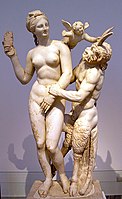
The and so-called Slipper Slapper Group: Aphrodite and Eros fighting off the advances of Pan. Marble, Hellenistic artwork from the tardily second century BC.
-

Hellenistic sculpture fragments from the National Archaeological Museum, Athens
Paintings and mosaics [edit]
Paintings and mosaics were important mediums in art, just no examples of paintings on panels have survived the fall to the Romans. Information technology is possible to get some idea of what they were like from related media, and what seem to be copies of or loose derivations from paintings in a wider range of materials.
Landscape [edit]
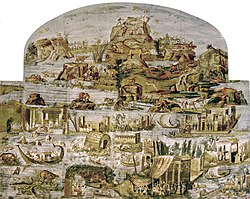
Perchance the virtually striking element of Hellenistic paintings and mosaics is the increased employ of landscape.[36] Landscapes in these works of art are representative of familiar naturalistic figures while also displaying mythological and sacro-idyllic elements.[37] Mural friezes and mosaics were commonly used to display scenes from Hellenistic poesy such as that past Herondas and Theocritos. These landscapes that expressed the stories of Hellenistic writers were utilized in the dwelling house to emphasize that family'due south pedagogy and knowledge well-nigh the literary world.[38]
Sacro-idyllic means that the most prominent elements of the artwork are those related to sacred and pastoral themes.[39] This mode that emerged most prevalently in Hellenistic fine art combines sacred and profane elements, creating a dreamlike setting.[40] Sacro-idyllic influences are conveyed in the Roman mosaic "Nile Mosaic of Palestrina" which demonstrates fantastical narratives with a color scheme and commonplace components that illustrate the Nile in its passage from Federal democratic republic of ethiopia to the Mediterranean. The inclusion of Hellenistic backgrounds can likewise exist seen in works throughout Pompeii, Cyrene, Alexandria. Moreover, specifically in Southern Russian federation, floral features and branches can exist plant on walls and ceilings strewn in a disordered yet conventional manner, mirroring a late Greek style.[41] In add-on, "Cubiculum" paintings institute in Villa Boscoreale include vegetation and a rocky setting in the background of detailed paintings of k architecture.
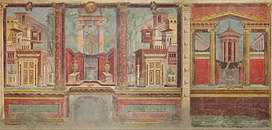
Roman fresco painting known as "Cubiculum" (chamber) from the Villa of P. Fannius Synistor at Boscoreale, fifty–twoscore B.C. Metropolitan Museum of Fine art 03.xiv.13a–g.
Wall paintings [edit]

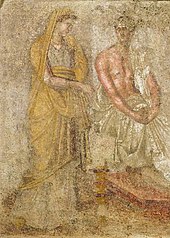
Hellenistic terra cotta funerary wall painting, tertiary century BC
Wall paintings began actualization more prominently in the Pompeian flow. These wall paintings were not merely displayed in places of worship or in tombs.[42] Often, wall paintings were used to decorate the dwelling. Wall paintings were common in individual homes in Delos, Priene, Thera, Pantikapaion, Olbia, and Alexandria.[42]
Few examples of Greek wall paintings have survived the centuries. The about impressive, in terms of showing what high-quality Greek painting was like, are those at the Macedonian majestic tombs at Vergina. Though Greek painters are given tribute to bringing cardinal ways of representation to the Western Globe through their art. Iii main qualities unique to Hellenistic painting way were three-dimensional perspective, the use of calorie-free and shade to render form, and trompe-l'œil realism.[43] Very few forms of Hellenistic Greek painting survive except for wooden pinakes panels and those painted on rock. The well-nigh famously known stone paintings are plant on the Macedonian Tomb at Agios Athanasios.[43]
Researchers have been express to studying the Hellenistic influences in Roman frescoes, for example those of Pompeii or Herculaneum. In add-on, some of the paintings in Villa Boscoreale clearly echo lost Hellenistic, Macedonian royal paintings.[44]
Mediums and technique [edit]
Recent excavations from the Mediterranean have revealed the technology used in Hellenistic painting.[45] Wall art of this period utilized two techniques: secco technique and fresco technique.[45] Fresco technique required layers of lime-rich plaster to then decorate walls and stone supports.[45] On the other hand, no base was necessary for the secco technique, which used mucilage arabic and egg tempera to paint finalizing details on marble or other stone.[45] This technique is exemplified in the Masonry friezes establish in Delos.[45] Both techniques used mediums that were locally attainable, such as terracotta aggregates in the base layers and natural inorganic pigments, synthetic inorganic pigments, and organic substances equally colorants.[45]

Contempo discoveries [edit]
Contempo discoveries include those of chamber tombs in Vergina (1987) in the onetime kingdom of Macedonia, where many friezes have been unearthed.[36] For example, in Tomb II archaeologists found a Hellenistic-manner frieze depicting a lion hunt.[46] This frieze found in the tomb supposedly that of Philip 2 is remarkable by its composition, the arrangement of the figures in space and its realistic representation of nature.[47] Other friezes maintain a realistic narrative, such every bit a symposium and feast or a military escort, and possibly retell historical events.[46]
There is also the recently restored 1st-century Nabataean ceiling frescoes in the Painted Firm at Little Petra in Jordan.[48] As the Nabataeans traded with the Romans, Egyptians, and Greeks, insects and other animals observed in the paintings reflect Hellenism while various types of vines are associated with the Greek god, Dionysus.[48]
Recent archaeological discoveries at the cemetery of Pagasae (close to modernistic Volos), at the edge of the Pagasetic Gulf accept brought to light some original works. The excavations of this site led by Dr. Arvanitopoulos may exist connected to various Greek painters in the 3rd and 4th centuries and depict scenes that allude to the reign of Alexander the Great.[49] [50]
In the 1960s, a group of wall paintings was found on Delos.[51] It is axiomatic that the fragments of friezes found were created by a customs of painters who lived during the belatedly Hellenistic menses.[52] The murals emphasized domestic decoration, conveying the belief these people held that the Delian establishment would remain stable and secure plenty for this artwork to be enjoyed by homeowners for many years to come up.[52]
Mosaics [edit]

Certain mosaics, however, provide a pretty good idea of the "grand painting" of the menstruum: these are copies of frescoes. This art form has been used to decorate primarily walls, floors, and columns.[53]
Mediums and technique [edit]
The evolution of mosaic art during the Hellenistic Period began with Pebble Mosaics, all-time represented in the site of Olynthos from 5th century BC. The technique of Pebble Mosaics consisted of placing small white and black pebbles of no specific shape, in a circular or rectangular console to illustrate scenes of mythology. The white pebbles -in slightly dissimilar shades- were placed on a black or blue background to create the epitome. The black pebbles served to outline the image.[54]
In the mosaics from the site of Pella, from the quaternary century BC, it is possible to see a more evolved form of the art. Mosaics from this site display the use of pebbles that were shaded in a wider range of colors and tones. They too evidence early use of terra-cotta and atomic number 82 wire to create a greater definition of contours and details to the images in the mosaics.[54]
Following this example, more materials were gradually added. Examples of this extended employ of materials in mosaics of the tertiary century BC include finely cut stones, chipped pebbles, drinking glass and baked clay, known as tessarae. This improved the technique of mosaics by aiding the artists in creating more definition, greater detail, a better fit, and an even wider range of colors and tones.[54]

Example of tesserae used in mosaics.
Despite the chronological order of the appearance of these techniques, in that location is no actual evidence to suggest that the tessellated necessarily developed from the pebble mosaics.[55]
Opus vermiculatum and opus tessellatum were 2 different techniques used during this period of mosaic making. Opus tessellatum refers to a redacted tessera (a small block of stone, tile, glass, or other fabric used in the construction of a mosaic) size followed by an increased variety in shape, colour, and material too as andamento––or the pattern in which the tessera was laid. Opus vermiculatum is oftentimes partnered with this technique but differs in complexity and is known to have the highest visual impact.[54]
The majority of mosaics were produced and laid on site. Yet, a number of floor mosaics display the use of the emblemata technique, in which panels of the paradigm are created off-site in trays of terra-cotta or stone. These trays were after placed into the setting-bed on the site.[54]
At Delos, colored grouts were used on opus vermiculatum mosaics, just in other regions this is not common. There is 1 case of colored grout used in Alexandria on the Dog and Askos mosaic. At Samos, the grouts and the tesserae are both colored.
Studying color hither is difficult as the grouts are extremely fragile and vulnerable.
Scientifics research has been a source of interesting information with regard to the grouts and tesserae used in Hellenistic Mosaics. Lead strips were discovered on mosaics as a definiting characteristic of the surface technique. Lead strips are absent from the mosaics here. At Delos, lead strips were common on mosaics in the opus tessellatum style. These strips were used to outline decorative borders and geometric decorative motifs. The strips were extremely mutual on opus vermiculatum mosaics from Alexandria. Because atomic number 82 strips were present in both styles of surface types, they cannot be the sole feature of 1 type or the other.[56]
Tel Dor mosaic [edit]

Particular of mosaic from Tel Dor circa 1st-second centuries. Found in Ha-Mizgaga Museum in Kibbutz Nahsholim, Israel.
A rare example of virtuoso Hellenistic style movie mosaic found in the Levantine declension. Through a technical analysis of the mosaic, researchers advise that this mosaic was created by itinerant craftsman working in situ. Since 2000, over 200 fragments of the mosaic accept been discovered at the headline of Tel Dor, however, the destruction of the original mosaic is unknown.[57] Excavators suggest that earthquake or urban renewal is the cause. Original architectural context is unknown, but stylistic and technical comparisons advise a late Hellenistic period date, estimating around the 2d half of the second century B.C.East. Analyzing the fragments establish at the original site, researchers accept found that the original mosaic contained a centralized rectangle with unknown iconography surrounded by a series of decorative borders consisting of a perspective meander followed by a mask-and-garland border.[57] This mosaic consists of 2 different techniques of mosaic making, opus vermiculatum and opus tessellatum.[57]
Alexander mosaic [edit]
An example is the Alexander Mosaic, showing the confrontation of the young conquistador and the Grand Rex Darius III at the Battle of Issus, a mosaic from a floor in the House of the Faun at Pompeii (now in Naples). It is believed to be a copy of a painting described by Pliny which had been painted past Philoxenus of Eretria for King Cassander of Macedon at the end of the quaternary century BC,[58] or even of a painting by Apelles contemporaneous with Alexander himself.[59] The mosaic allows us to admire the choice of colors along with the limerick of the ensemble using turning movement and facial expression.
Stag Hunt mosaic [edit]
The Stag Hunt Mosaic by Gnosis is a mosaic from a wealthy home of the late 4th century BC, the and so-called "Business firm of the Abduction of Helen" (or "Firm of the Rape of Helen"), in Pella, The signature ("Gnosis epoesen", i.e. Gnosis created) is the commencement known signature of a mosaicist.[60]
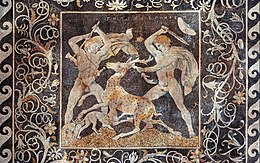
The emblema is bordered by an intricate floral pattern, which itself is bordered past stylized depictions of waves.[62] The mosaic is a pebble mosaic with stones collected from beaches and riverbanks which were gear up into cement.[62] Every bit was perhaps often the instance,[63] the mosaic does much to reflect styles of painting.[64] The calorie-free figures against a darker groundwork may allude to ruby-red figure painting.[64] The mosaic too uses shading, known to the Greeks as skiagraphia, in its depictions of the musculature and cloaks of the figures.[64] This along with its use of overlapping figures to create depth renders the image three dimensional.
Sosos [edit]
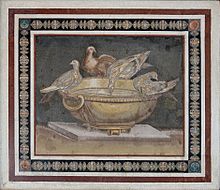
The Hellenistic period is equally the time of development of the mosaic as such, specially with the works of Sosos of Pergamon, active in the 2nd century BC and the only mosaic artist cited by Pliny.[65] His gustatory modality for trompe-50'œil (optical illusion) and the effects of the medium are found in several works attributed to him such as the "Unswept Floor" in the Vatican museum,[66] representing the leftovers of a repast (fish bones, bones, empty shells, etc.) and the "Dove Basin" (made of modest opus vermiculatum tesserae stones)[67] at the Capitoline Museum, known by means of a reproduction discovered in Hadrian'southward Villa.[68] In it i sees iv doves perched on the edge of a aureate statuary basin filled with water. One of them is watering herself while the others seem to be resting, which creates effects of reflections and shadow perfectly studied by the artist. The "Dove Basin" mosaic panel is an emblema, designed to exist the central point of an otherwise plain mosaic floor. The emblema was originally an import from the Hellenistic eastern Mediterranean, where, in cities such every bit Pergamom, Ephesus and Alexandria, there were artists specializing in mosaics.[67] One of them was Sosos of Pergamon, the most celebrated mosaicist of artifact who worked in the second century BC.[67]
Delos [edit]
According to the French archaeologist François Chamoux, the mosaics of Delos in the Cyclades represent the zenith of Hellenistic-period mosaic art employing the employ of tesserae to form complex, colorful scenes.[69] This style of mosaic continued until the stop of Artifact and may have had an touch on the widespread use of mosaics in the Western world during the Heart Ages.[69]
-

-
-

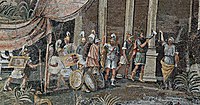
Fragments of landscape paintings from Delos, c. 100 BC
-

The Sampul tapestry, a woollen wall hanging from Lop County, Hotan Prefecture, Xinjiang, China, showing a possibly Greek soldier from the Greco-Bactrian kingdom (250–125 BC), with blue eyes, wielding a spear, and wearing what appears to be a diadem headband; depicted above him is a centaur, from Greek mythology, a common motif in Hellenistic art;[70] Xinjiang Region Museum.
-

particular of Nabataen ceiling frescoes painted on plastered ceiling.
Pottery [edit]
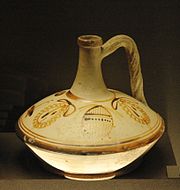
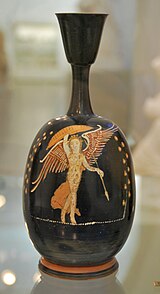
The Hellenistic Historic period comes immediately after the groovy age of painted Ancient Greek pottery, perhaps because increased prosperity led to more than employ of fine metalware (very little at present surviving) and the decline of the fine painted "vase" (the term used for all vessel shapes in pottery). Most vases of the period are black and uniform, with a shiny appearance approaching that of varnish, decorated with simple motifs of flowers or festoons. The shapes of the vessels are often based on metalwork shapes: thus with the lagynos, a wine jar typical of the flow. Painted vase types that continued production into the Hellenistic menses include Hadra vases and Panathenaic amphora.
Megarian ware [edit]
It is also the menses of so-called Megarian ware:[72] mold-made vases with decoration in relief appeared, doubtless in simulated of vases made of precious metals. Wreaths in relief were applied to the body of the vase. Ane finds besides more complex relief, based on animals or legendary creatures.
West Slope ware [edit]
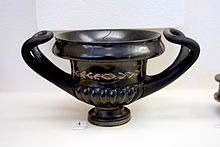
Reddish-effigy painting had died out in Athens by the end of the 4th century BC to be replaced past what is known as West Slope Ware, so named afterward the finds on the west slope of the Athenian Acropolis. This consisted of painting in a tan coloured slip and white paint on a fired black skid background with some incised detailing.[73]
Representations of people diminished, replaced with simpler motifs such as wreaths, dolphins, rosettes, etc. Variations of this style spread throughout the Greek world with notable centres in Crete and Apulia, where figural scenes continued to exist in need.
Apulian [edit]

Gnathia vases [edit]
Gnathia vases nonetheless were still produced not just in Apulian, but also in Campanian, Paestan and Sicilian vase painting.

Centuripe vase in Palermo, 280–220 BC
Canosa ware [edit]
In Canosa di Puglia in South Italy, in third century BC burials one might find vases with fully 3-dimensional attachments.[74] The distinguishing feature of Canosa vases are the water-soluble paints. Blueish, ruby-red, xanthous, low-cal imperial and brown paints were practical to a white ground.
Centuripe ware [edit]
The Centuripe ware of Sicily, which has been called "the last gasp of Greek vase painting",[one] had fully coloured tempera painting including groups of figures applied after firing, contrary to the traditional practise. The fragility of the pigments prevented frequent utilize of these vases; they were reserved for apply in funerals, and many were purely for display, for example with lids that did not lift off. The practice possibly continued into the second century BC, making it perhaps the terminal vase painting with significant figures.[75] A workshop was active until at least the 3rd century BC. These vases are characterized by a base of operations painted pink. The figures, often female person, are represented in coloured clothing: blue-violet chiton, yellowish himation, white veil. The style is reminiscent of Pompeii and draws more from yard gimmicky paintings than on the heritage of the red-figure pottery.
Terracotta figurines [edit]
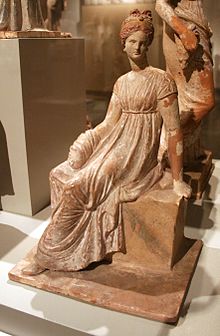
Bricks and tiles were used for architectural and other purposes. Production of Greek terracotta figurines became increasingly important. Terracotta figurines represented divinities besides equally subjects from contemporary life. Previously reserved for religious utilize, in Hellenistic Hellenic republic the terracotta was more than oft used for funerary and purely decorative, purposes. The refinement of molding techniques fabricated information technology possible to create true miniature statues, with a high level of item, typically painted.
Several Greek styles connected into the Roman flow, and Greek influence, partly transmitted via the Ancient Etruscans, on Ancient Roman pottery was considerable, especially in figurines.
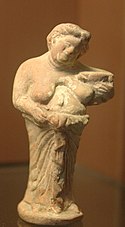
A grotesque woman property a jar of wine, Kertch, second half of quaternary century BC, Louvre.
Tanagra figurines [edit]
Tanagra figurines, from Tanagra in Boeotia and other centers, full of lively colours, nearly oftentimes represent elegant women in scenes full of charm.[76] At Smyrna, in Asia Pocket-sized, two major styles occurred side-by-side: starting time of all, copies of masterpieces of great sculpture, such as the Farnese Hercules in gilt terra cotta.
Grotesques [edit]
In a completely different genre, in that location are the "grotesques", which dissimilarity violently with the canons of "Greek beauty": the koroplathos (figurine maker) fashions deformed bodies in tortuous poses – hunchbacks, epileptics, hydrocephalics, obese women, etc. One could therefore wonder whether these were medical models, the town of Smyrna beingness reputed for its medical school. Or they could simply be caricatures, designed to provoke laughter. The "grotesques" are equally common at Tarsus and also at Alexandria.
Negro [edit]
One theme which emerged was the "negro", particularly in Ptolemaic Egypt: these statuettes of Black adolescents were successful upwards to the Roman period.[77] Sometimes, they were reduced to echoing a class from the great sculptures: thus one finds numerous copies in miniature of the Tyche (Fortune or Run a risk) of Antioch, of which the original dates to the beginning of the 3rd century BC.
Hellenistic pottery designs can exist plant in the city of Taxila in modern Islamic republic of pakistan, which was colonized with Greek artisans and potters later on Alexander conquered it.
-

Female head partially imitating a vase (lekythos), 325-300 BC.
-
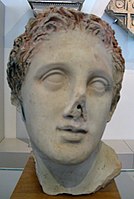
Aboriginal Greek terracotta caput of a swain, found in Tarent, ca. 300 BC, Antikensammlung Berlin.
-

Tanagra figurine playing a pandura, 200 BC
Minor arts [edit]
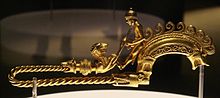
Metallic art [edit]
Considering of then much bronze statue melting, merely the smaller objects still exist. In Hellenistic Greece, the raw materials were plentiful following eastern conquests.

The work on metal vases took on a new fullness: the artists competed among themselves with great virtuosity. The Thracian Panagyurishte Treasure (from mod Bulgaria), includes Greek objects such equally a gold amphora with two rearing centaurs forming the handles.

The Derveni Krater, from most Thessaloniki, is a big bronze volute krater from nearly 320 BC, weighing 40 kilograms, and finely decorated with a 32-centimetre-tall frieze of figures in relief representing Dionysus surrounded by Ariadne and her procession of satyrs and maenads.[78] The neck is busy with ornamental motifs while four satyrs in high relief are casually seated on the shoulders of the vase.
The development is like for the art of jewelry. The jewelers of the time excelled at handling details and filigrees: thus, the funeral wreaths nowadays very realistic leaves of trees or stalks of wheat. In this period the insetting of precious stones flourished.
Glass and glyptic art [edit]
It was in the Hellenistic catamenia that the Greeks, who until then just knew molded glass, discovered the technique of glass blowing, thus permitting new forms. Beginning in Syria,[79] the art of glass developed especially in Italy. Molded glass continued, notably in the cosmos of intaglio jewelry.
The art of engraving gems inappreciably advanced at all, limiting itself to mass-produced items that lacked originality. Every bit compensation, the cameo made its advent. Information technology concerns cutting in relief on a stone equanimous of several colored layers, allowing the object to be presented in relief with more than one colour. The Hellenistic period produced some masterpieces similar the Gonzaga cameo, now in the Hermitage Museum, and spectacular hardstone carvings like the Cup of the Ptolemies in Paris.[80]
Coinage [edit]
Coinage in the Hellenistic menstruation increasingly used portraits.[81]
-

The golden larnax of Philip II of Macedon which contained his remains. It was constructed in 336 BC. It weighs 11 kilos and is made of 24 carat gold. Vergina, Greece.
-
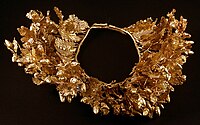
The golden wreath of Philip Two found within the golden larnax. It weighs 717 grams.
-

The Gonzaga Cameo 3rd century BC, in the Hermitage Museum, St. petersburg
-

Apollonios of Athens, gilt ring with portrait in garnet, c. 220 BC
Later Roman copies [edit]
Spurred past the Roman acquisition, elite consumption and demand for Greek art, both Greek and Roman artists, particularly later the establishment of Roman Greece, sought to reproduce the marble and bronze artworks of the Classical and Hellenistic periods. They did so by creating molds of original sculptures, producing plaster casts that could be sent to whatsoever sculptor's workshop of the Mediterranean where these works of art could exist duplicated. These were often faithful reproductions of originals, nevertheless other times they fused several elements of various artworks into ane grouping, or simply added Roman portraiture heads to preexisting athletic Greek bodies.[82]
-

Drunken old woman clutching a lagynos. Marble, Roman re-create after a Greek original of the 2nd century BC, credited to Myron.
-
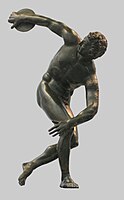
Roman bronze reduction of Myron'southward Discobolos, 2nd century Advert
-

-

Child playing with a goose. Roman copy (1st–2nd centuries AD) of a Greek original, in the Louvre.
-

The Tyche of Antioch. Roman re-create after a Greek bronze original by Eutychides of the tertiary century BC.
-

Old market woman, Roman artwork later a Hellenistic original of the 2nd century BC.
-

Crouching Aphrodite, marble copy from the 1st century BC after a Hellenistic original of the third century BC.
-
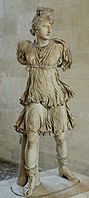
Artemis of the Rospigliosi type. Marble, Roman artwork of the Majestic Era, 1st–2nd centuries AD. Re-create of a Greek original, Louvre
-

The Farnese Hercules, probably an enlarged copy made in the early 3rd century Advertising and signed past a certain Glykon, from an original by Lysippos (or i of his circle) that would have been fabricated in the quaternary century BC; the copy was fabricated for the Baths of Caracalla in Rome (dedicated in 216 Advertisement), where it was recovered in 1546
Come across too [edit]
- Alexander the Swell
- Hellenistic civilisation
- Hellenistic Greece
- Hellenistic flow
- Fine art in ancient Greece
- Pottery of Aboriginal Hellenic republic
- Ancient Greek vase painting
- Greek sculpture
- Hellenistic influence on Indian fine art
- Parthian art
- Bacchic art
References and sources [edit]
- References
- ^ a b Pedley, p. 339 harvnb error: no target: CITEREFPedley (help)
- ^ Burn, p. sixteen harvnb fault: no target: CITEREFBurn (help)
- ^ Pollitt, p. 22 harvnb error: no target: CITEREFPollitt (assist)
- ^ Bolman 2016, pp. 120–121
- ^ Winter, p. 42
- ^ Anderson, p. 161 harvnb error: no target: CITEREFAnderson (aid)
- ^ Havelock, p. ? harvnb error: no target: CITEREFHavelock (help)
- ^ Pedley, p. 348 harvnb error: no target: CITEREFPedley (assist)
- ^ Cahill, Nicholas (2002). Household and Metropolis System at Olynthus. Yale University Press. pp. 74–78. ISBN9780300133004.
- ^ Burn, p. 92 harvnb error: no target: CITEREFBurn (help)
- ^ Pliny the Elder, Natural History (XXXIV, 52)
- ^ a b Richter, p. 233 harvnb error: no target: CITEREFRichter (assist)
- ^ Smith, 33–twoscore, 136–140
- ^ Paul Lawrence. "The Classical Nude". p. 5.
- ^ Smith, 127–154
- ^ Green, pp. 39–xl harvnb error: no target: CITEREFGreen (help)
- ^ Boardman, p. 179 harvnb fault: no target: CITEREFBoardman (assistance)
- ^ Studies in the History of Art. National Gallery of Art. i January 1999. ISBN9780300077339 – via Google Books.
- ^ Winter, p. 235
- ^ Paul Lawrence. "The Classical Nude". p. 4.
- ^ Boardman, 199
- ^ Pollitt, p. 110 harvnb error: no target: CITEREFPollitt (help)
- ^ Richter, p. 234 harvnb error: no target: CITEREFRichter (help)
- ^ Singleton, p. 165 harvnb error: no target: CITEREFSingleton (help)
- ^ "Scientific American". Munn & Company. ane January 1905 – via Google Books.
- ^ Burn, p. 160 harvnb error: no target: CITEREFBurn (assistance)
- ^ a b c Pedley, p. 371 harvnb mistake: no target: CITEREFPedley (help)
- ^ Lessing contra Winckelmann
- ^ Richter, p. 237 harvnb mistake: no target: CITEREFRichter (help)
- ^ Klein, Wilhelm (1921). Vom antiken Rokoko (in German). Hölzel: Österreichische Verlagsgesellschaft.
- ^ Klein, Wilhelm (1909). "Die Aufforderung zum Tanz. Eine wiedergewonnene Gruppe des antiken Rokoko". Zeitschrift für bildende Kunst. 20: 101–108.
- ^ Habetzeder, Julia (1 November 2021). "The Invitation to the Dance. An intertextual reassessment". Opuscula. Annual of the Swedish Institutes at Athens and Rome. 14: 419–463. doi:x.30549/opathrom-14-19. ISSN 2000-0898. S2CID 239854909.
- ^ Junker, Klaus (2008). Original und Kopie. Formen und Konzepte der Nachahmung in der antiken Kunst (in High german). Wiesbaden: Reichert Verlag. pp. 77–108. ISBN978-3-89500-629-6.
- ^ Smith, 240–241
- ^ Smith, 258–261
- ^ a b Pedley, p. 377 harvnb mistake: no target: CITEREFPedley (help)
- ^ "Emory Libraries Resource Terms of Utilise - Emory Academy Libraries". ebookcentral.proquest.com . Retrieved sixteen Nov 2018.
- ^ Schefold, Karl (Summer 1960). "Origins of Roman Mural Painting". The Art Bulletin. 42 (2): 87–96. doi:ten.1080/00043079.1960.11409078. JSTOR 3047888.
- ^ Ling, Roger (1977). "Studius and the Ancestry of Roman Landscape Painting". The Journal of Roman Studies. 67: i–16. doi:ten.2307/299914. JSTOR 299914.
- ^ "Wind Towers in Roman Wall Paintings" (PDF). metmuseum.org . Retrieved 16 November 2018.
- ^ Rostovtzeff, One thousand. (1919). "Ancient Decorative Wall-Painting". The Journal of Hellenic Studies. 39: 144–163. doi:10.2307/624878. JSTOR 624878.
- ^ a b Rostovtzeff, M (1919). "Aboriginal Decorative Wall-Painting". The Journal of Hellenic Studies. 39: 144–163. doi:10.2307/624878. JSTOR 624878.
- ^ a b Abbe, Mark B. "Painted Funerary Monuments from Hellenistic Alexandria". In Heilbrunn Timeline of Art History. New York: The Metropolitan Museum of Art, 2000–. http://world wide web.metmuseum.org/toah/hd/pfmh/hd_pfmh.htm (April 2007)
- ^ http://www.metmuseum.org/toah/hd/haht/hd_haht.htm[ bare URL ]
- ^ a b c d e f Kakoulli, Ioanna (2002). "Belatedly Classical and Hellenistic painting techniques and materials: a review of the technical literature". Studies in Conservation. 47 (Supplement-1): 56–67. doi:ten.1179/sic.2002.47.Supplement-one.56. ISSN 0039-3630. S2CID 191474484.
- ^ a b Palagia, Olga. ""THE ROYAL COURT IN ANCIENT Republic of macedonia: THE Testify FOR Purple TOMBS," in A. Erskine et al. (eds.), The Hellenistic Court (Bristol 2017)".
- ^ Pollitt, p. forty harvnb error: no target: CITEREFPollitt (help)
- ^ a b Alberge, Dalya (21 Baronial 2010). "Discovery of aboriginal cave paintings in Petra stuns art scholars". The Observer . Retrieved xiv April 2015.
- ^ Fowler, Harold Due north; Wheeler, James Rignall; Stevens, Gorham Phillips (1909). A Handbook of Greek Archeology. Biblo & Tannen Publishers. ISBN9780819620095.
- ^ Chisholm, Hugh (1913). The Britannica Year Volume. Encyclopœdia Britannica Visitor, Limited.
- ^ Bruno, p. i harvnb error: no target: CITEREFBruno (aid)
- ^ a b Bruno, Vincent J. (1985). Hellenistic Painting Techniques: The Evidence of the Delos Fragments. BRILL. ISBN978-9004071599.
- ^ Harding, Catherine (2003). "Mosaic | Grove Fine art". 1. doi:10.1093/gao/9781884446054.commodity.t059763. ISBN978-1-884446-05-four . Retrieved 16 November 2018.
- ^ a b c d east Harding, Catherine (2003). "Mosaic | Grove Art". one. doi:10.1093/gao/9781884446054.commodity.t059763. ISBN978-1-884446-05-4 . Retrieved 28 November 2018.
- ^ Dunbabin, Katherine Chiliad. D. (1979). "Technique and Materials of Hellenistic Mosaics". American Journal of Archaeology. 83 (3): 265–277. doi:10.2307/505057. JSTOR 505057. S2CID 193097937.
- ^ Wootton, Will (Spring 2012). "Making and Meaning: The Hellenistic Mosaic from Tel Dor". American Journal of Archeology. 116 (2): 209–234. doi:x.3764/aja.116.2.0209. JSTOR 10.3764/aja.116.two.0209. S2CID 194498598.
- ^ a b c Wooton, Will (2012). "Making and Meaning: The Hellenistic Mosaic from Tel Dor". American Journal of Archaeology. 116 (2): 209–234. doi:10.3764/aja.116.2.0209. JSTOR 10.3764/aja.116.ii.0209. S2CID 194498598.
- ^ Pliny the Elder, Natural History (XXXV, 110)
- ^ Kleiner, p. 142 harvnb error: no target: CITEREFKleiner (assist)
- ^ Mosaics of the Greek and Roman world By Katherine 1000. D. Dunbabin pg. 14
- ^ Chugg, Andrew (2006). Alexander'south Lovers. Raleigh, North.C.: Lulu. ISBN 978-i-4116-9960-1, pp 78–79.
- ^ a b Kleiner and Gardner, pg. 135
- ^ "The history of mosaic art".
- ^ a b c Kleiner and Gardner, pg. 136
- ^ Pliny the Elder, Natural History (XXXVI, 184)
- ^ "Asarotos oikos: The unswept room".
- ^ a b c "Fine art and sculptures from Hadrian's Villa: Mosaic of the Doves". Post-obit HADRIAN. 13 June 2014. Retrieved 26 November 2018.
- ^ Havelock, p. ? harvnb error: no target: CITEREFHavelock (aid) [ verification needed ]
- ^ a b Chamoux 2002, p. 375
- ^ Christopoulos, Lucas (August 2012). "Hellenes and Romans in Ancient China (240 BC – 1398 Advert)", in Victor H. Mair (ed), Sino-Platonic Papers, No. 230. Chinese Academy of Social Sciences, University of Pennsylvania Section of E Asian Languages and Civilizations. ISSN 2157-9687, pp. xv–16.
- ^ Fletcher, Joann (2008). Cleopatra the Great: The Woman Behind the Legend. New York: Harper. ISBN 978-0-06-058558-7, epitome plates and captions between pp. 246-247.
- ^ Pedley, p. 382 harvnb fault: no target: CITEREFPedley (help)
- ^ Burn down, p. 117 harvnb error: no target: CITEREFBurn (help)
- ^ Pedley, p. 385 harvnb error: no target: CITEREFPedley (assistance)
- ^ Von Bothner, Dietrich, Greek vase painting, p. 67, 1987, Metropolitan Museum of Art (New York, N.Y.)
- ^ Masseglia, p. 140 harvnb error: no target: CITEREFMasseglia (help)
- ^ Three Centuries of Hellenistic Terracottas
- ^ Burn, p. 30 harvnb fault: no target: CITEREFBurn (assist)
- ^ Honour, p. 192 harvnb error: no target: CITEREFHonour (help)
- ^ Pollitt, p. 24 harvnb fault: no target: CITEREFPollitt (assistance)
- ^ "Hellenistic Coin Portraits".
- ^ Department of Greek and Roman Fine art (Oct 2002). "Roman Copies of Greek Statues." In Heilbrunn Timeline of Art History. New York: The Metropolitan Museum of Art. Retrieved 17 Oct 2016.
- ^ Capitoline Museums. "Jumbo statue of Mars Ultor too known equally Pyrrhus - Inv. Scu 58." Capitolini.info. Retrieved eight October 2016.
- Sources
- This article draws heavily on the fr:Art hellénistique article in the French-language Wikipedia, which was accessed in the version of 10 Nov 2006.
- Anderson, William J. (1 June 1927). The Compages of Ancient Greece. London: Harrison, Jehring, & Co. ISBN978-0404147259.
- Boardman, John (1989). Greek Fine art . London: Thames and Hudson. ISBN978-0-500-20292-0.
- Boardman, John (18 November 1993). The Oxford History of Classical Fine art. Oxford University Printing. ISBN0-19-814386-9.
- Bolman, Elizabeth S. (2016). "A Staggering Spectacle: Early Byzantine Aesthetics in the Triconch". In Bolman, Elizabeth Due south. (ed.). The Red Monastery Church building: Dazzler and Asceticism in Upper Egypt. New Haven & London: Yale Academy Press; American Research Center in Egypt, Inc. pp. 119–128. ISBN978-0-300-21230-3.
- Bruno, Vincent 50. (1985). Hellenistic Painting Techniques: The Show of the Delos Fragments. ISBN978-9004071599.
- Burn, Lucilla (2005). Hellenistic Fine art: From Alexander The Swell To Augustus. Los Angeles: J. Paul Getty Trust Publications. ISBN978-0-89236-776-four.
- Chamoux, Françios (2002) [1981]. Hellenistic Civilization. Translated by Michel Roussel. Oxford: Blackwell. ISBN978-0631222422.
- Charbonneaux, Jean, Jean Martin and Roland Villard (1973). Hellenistic Greece. Peter Green (trans.). New York: Braziller. ISBN978-0-8076-0666-7.
{{cite volume}}: CS1 maint: multiple names: authors listing (link) - Light-green, Peter (19 Oct 1993). Alexander to Actium: The Historical Development of the Hellenistic Historic period . ISBN978-0520083493.
- Havelock, Christine Mitchell (1968). Hellenistic Art . Greenwich, Connecticut: New York Graphic Society Ltd. ISBN978-0-393-95133-2.
- Holtzmann, Bernard and Alain Pasquier (2002). Histoire de 50'art antique: l'fine art grec. Réunion des musées nationaux. ISBN978-ii-7118-3782-3.
- Honour, Hugh (2005). A Earth History of Art. ISBN978-1856694513.
- Kleiner, Fred Southward. (2008). Gardner'south Art Through the Ages: A Global History. Cengage Learning. ISBN978-0-495-11549-vi.
- Masseglia, Jane (2015). Body Language in Hellenistic Art and Society. ISBN978-0198723592.
- Pedley, John Griffiths (2012). Greek Art and Archaeology. ISBN978-0-205-00133-0.
- Pollitt, Jerome J. (1986). Art in the Hellenistic Age. Cambridge University Printing. ISBN978-0-521-27672-vi.
- Richter, Gisela Chiliad. A. (1970). The Sculpture and Sculptors of the Greeks .
- Singleton, Esther (1910). Famous sculpture as seen and described by great writers. Dodd, Mead & Visitor.
- Stewart, Andrew (2014). Fine art in the Hellenistic World: An Introduction. Cambridge University Press. ISBN978-1-107-62592-1.
- Winter, Frederick. Studies in Hellenistic Compages. ISBN978-0802039149.
- Zanker, Graham (2004). Modes of Viewing in Hellenistic Poetry and Fine art. University of Wisconsin Printing. ISBN978-0299194505.
Further reading [edit]
- Anderson, Jane E. A. Trunk Language in Hellenistic Art and Society. First edition. Oxford: Oxford Academy Press, 2015.
- Stewart, Andrew F. Art in the Hellenistic Earth: An Introduction. New York: Cambridge University Press, 2014.
- Trofimova, Anna A. Imitatio Alexandri in Hellenistic Art: Portraits of Alexander the Smashing and Mythological Images. Rome: L'Erma di Bretschneider, 2012.
- Zanker, G. Modes of Viewing in Hellenistic Poesy and Art. Madison: Academy of Wisconsin Printing, 2004.
External links [edit]
- Choice of Hellenistic works at the British Museum
- Selection of Hellenistic works at the Louvre
- Hellenistic Art, Ancient-Greece.org
Source: https://en.wikipedia.org/wiki/Hellenistic_art
Belum ada Komentar untuk "In Comparing Hellenic to Hellenistic Arts and Literature We Find That"
Posting Komentar